
⏱️ 4 min read
You have a project to build and you need capital to make it happen. As a community-focused organization, you’re also thinking about where the capital comes from and who gets to benefit from that investment.
What if more Canadians could invest directly in projects like yours?
The Canadian Coalition for Community Capital (4C) is working to change that. Co-founded by Tapestry Community Capital, the Coalition is a national advocacy network of more than 30 organizations working to strengthen the policy environment for community investment.
In its May 2026 pre-budget submission, the Coalition proposed five targeted federal reforms that would make community investment easier, safer, and more attractive to everyday Canadians — ultimately expanding the pool of investors interested in impact organizations like yours.
Here’s what each proposal could mean for organizations issuing community bonds.
1. A bigger pool of potential investors
Today, Canadians can technically hold a community bond or preferred co-op share in a registered account, but generally only if it is asset- or mortgage-backed. That’s a requirement many community organizations can’t meet, or can only meet at a prohibitive cost.
The Coalition is asking the government to allow unsecured community investments of up to $20,000 per year to qualify for registered accounts. That would let everyday investors benefit from the same tax sheltering available for other eligible investments. The annual limit would also help preserve the role of registered accounts as savings and retirement tools.
For you as an issuer, that could mean access to a much larger pool of investors including people who already have money set aside in RRSPs, TFSAs, or FHSAs, and would prefer to put some of it work in their community.
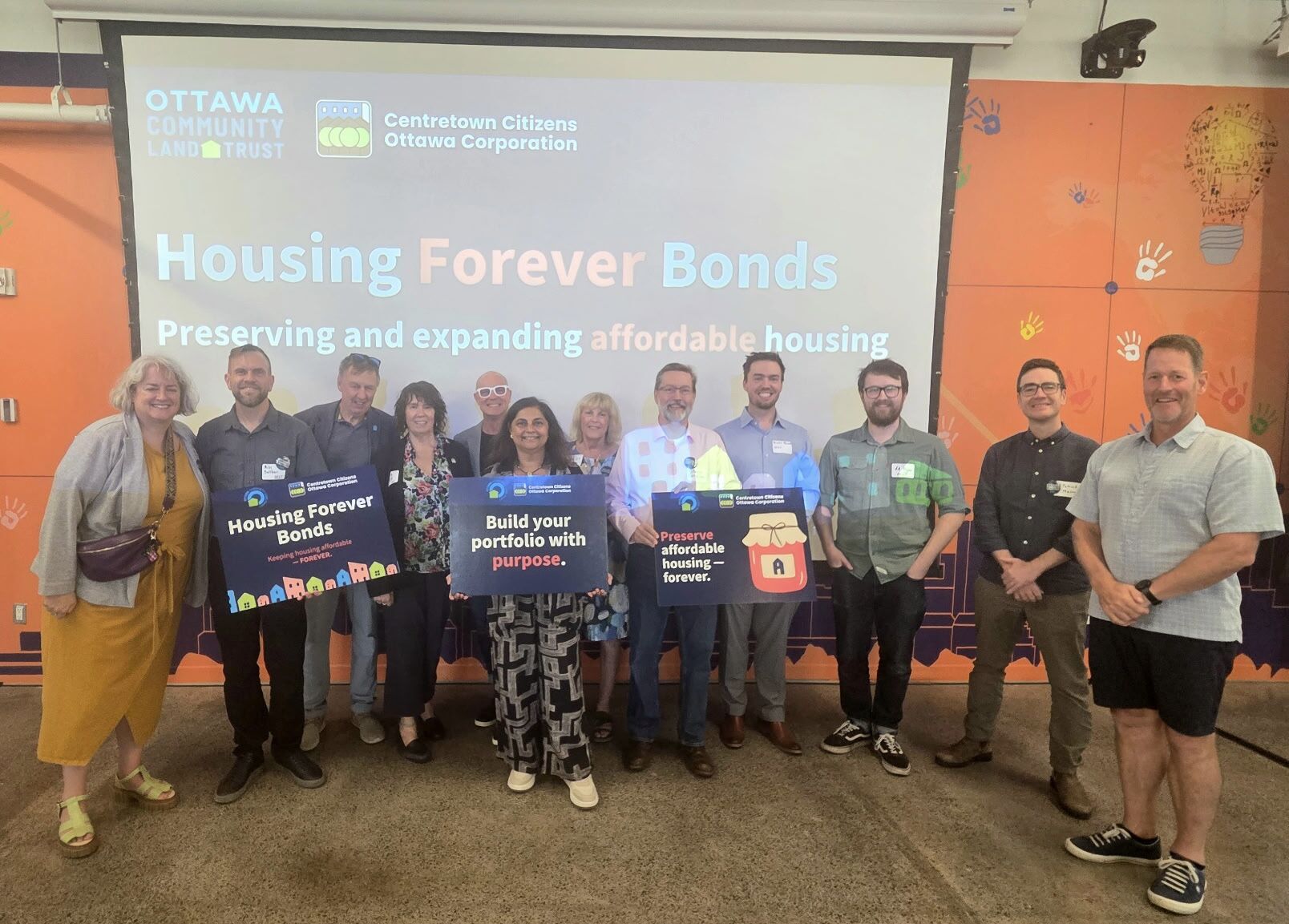
It also responds to something issuers are hearing directly from their bondholders. At the Ottawa Community Land Trust (OCLT), more than 200 investors have invested over $4.5 million in Housing Forever Bonds since 2024.
“We know that people are keen to invest their capital right here in the community to advance housing security for their neighbours,” OCLT Executive Director, Mike Bulthuis, says. “While this response is incredible, we know that other investors would come forward if investing in community was easier, or if they could add Housing Forever bonds to their RRSPs, TFSAs or First Home Savings Accounts.”


2. More protection if things go wrong
As with any investment, there are risks associated with investing in community bonds. For potential investors, uncertainty about losing their money can be a barrier to investing in the first place.
Tapestry’s Community Bondholder Survey found that approximately 25% of respondents identified concerns about risk or security when investing in community bonds.
The Coalition is proposing that investors be able to deduct 75% of losses on eligible community investments from their taxable income. If an investor loses money on an eligible community investment, they would be able to recover some of that loss through the tax system. The idea is to recognize the public benefit of these investments while reducing some of the financial risk for everyday investors.
For issuers, this could make it easier to have conversations with prospective investors who like your project but are concerned about what happens if the investment doesn’t work out. A policy that gives investors some protection could increase their confidence in community investment and make more people willing to consider your offering.
3. A stronger financial incentive to invest
People invest in community projects because they want their money to do good, but they also need the investment to make financial sense.
The Coalition is proposing a 30% Community Capital Tax Credit, made up of a 20% non-refundable credit and a 10% refundable credit. For investors, that would make the financial case for investing in community projects much stronger — especially for lower- and middle-income Canadians.
Over time, that could help organizations like yours build larger and more diverse investor bases – and keep more of the financial benefits of your projects within the communities you serve.

4. More ways for co-operatives to raise capital
If you’re a co-operative, your ability to raise capital can be limited by who is eligible to invest – mainly, your existing membership base. The fourth reform would allow co-operatives to raise investment capital beyond their membership.
That would give you more flexibility when you need to finance a project and open the door to new investors who support your work but aren’t members.
And even if you’re not a co-operative, this change could help grow the community investment market as a whole. The more organizations that raise community capital, the more people will encounter community investment, gain experience as investors, and become familiar with putting their money into local projects. A bigger and more familiar community investment market could make it easier for you to raise capital over time.
5. More support for organizations raising capital
As an issuer, you need the expertise, infrastructure, and financing tools to develop an offering and bring it to market. The Coalition’s fifth reform addresses this side of the equation. It calls for national accreditation for community finance issuers, incubators, and intermediaries, alongside a $250 million federal fund for technical assistance, guarantees, first-loss capital, and low-interest financing.
For organizations like yours, this could help address one of the less visible barriers to raising community capital: the infrastructure needed to actually build a successful offering.
What could these changes mean together?
Together, these changes could make it easier for Canadians to invest in community projects and easier for organizations like yours to raise the capital those projects need.
Independent economic modelling by Nordicity estimates that the reforms could mobilize up to $831 million in community capital over five years.
A stronger policy environment means more people can participate in community investment – and more organizations have a chance to raise the capital they need to build the projects their communities need.
Learn more about the Coalition’s five proposals here.