

 5 min read
Around tables across Canada, policymakers, community leaders, businesspeople and everyday Canadians are asking: What will it take to build a stronger, more resilient Canadian economy?
But there’s another question fewer are asking: Who gets to participate in building it?
Canadian households hold roughly $4 trillion in assets, yet very little of it currently reaches the community-led projects working to build affordable housing, clean energy, local infrastructure — the projects that directly build more resilient local economies. Over $3 trillion of everyday Canadians’ assets are in U.S. securities.
What would it look like if more Canadians could invest in our own communities?
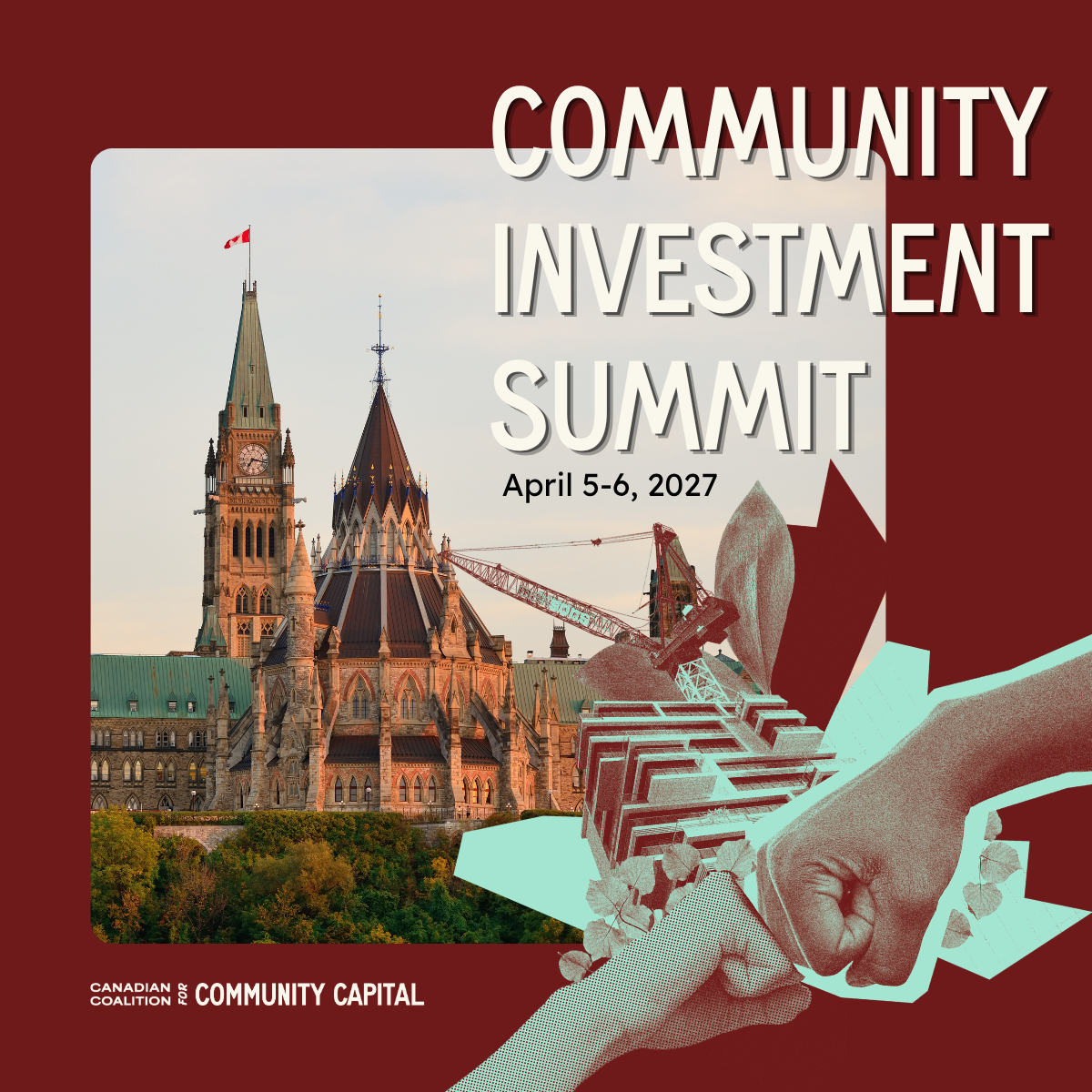
That’s the vision of the Community Investment Summit, happening April 5-6, 2027, in Ottawa, organized by the Canadian Coalition for Community Capital, a group of more than 30 organizations across Canada co-founded by Tapestry Community Capital.
The summit will bring together community leaders, policymakers, financial and investment leaders, foundations, researchers and other ecosystem partners to explore what it will take to make community investment a bigger part of how Canada builds.
We sat down with Tapestry’s Director of Growth & Partnerships, Stephanie Pinnington, to talk about why this moment matters, what needs to change, and what she hopes comes out of bringing the community investment movement together.
Why is Tapestry co-hosting the Community Investment Summit? Why Tapestry, and why now?
Stephanie: I think this is a really important time for the work that we’re doing. There’s been a convergence of things happening in global and local politics that makes this moment particularly relevant.
We’re seeing tariffs, trade tensions and a broader conversation about Canada’s economic sovereignty. At the same time, there’s growing recognition of the role that private capital, including investment from everyday Canadians, can play in building the country we want.
We have huge challenges around housing, climate and building resilient communities. Communities are already developing solutions to those challenges, but they often struggle to access the capital to make them happen.
This is the right moment to bring people together and ask what it would take to make that easier.
What are communities already doing that investors and policymakers should be paying more attention to?
Stephanie: Communities often know what they need better than government does at a high level. Government understands that we have a housing crisis and a climate crisis, but it doesn’t always see how those challenges are landing locally, day to day.
Communities see the problems and the solutions.
The challenge is that capital is often a barrier. We’ve seen affordable housing providers and grassroots organizations spend years trying to piece together financing, sometimes combining 10 different sources of capital – traditional financing, grants, donations and more. It’s hugely complex.
Community investment is unique because it puts power directly into the hands of communities. It gives them a way to act now rather than waiting for external decisions to be made on their behalf.
I think investors and policymakers should pay much more attention to what is already happening on the ground. There are incredible organizations actively addressing some of our biggest challenges, and community investment is one way to scale that work.
There’s also an opportunity for investors to think differently about what their capital can do. We can align our values with how we invest. We can find ways to use capitalism for good and create opportunities for Canadians to invest in things that matter to them and their communities.




What needs to change for community investment to become mainstream?
Stephanie: There are a few pieces. The Canadian Coalition for Community Capital is advocating for measures like a tax credit, loss deductibility and streamlined inclusion of community investments in registered accounts like RRSPs and TFSAs. These measures would help incentivize investment and reduce risk for investors. But the signal from government is just as important.
When government makes these changes, it tells Canadians that community investment is something it believes in. That recognition can help signal to retail investors that this is becoming a mainstream part of the financial system.
There’s also an important role for wealth advisors. Most Canadians still make investment decisions with the support of a wealth advisor, even as self-directed investing becomes more common.
As more Canadians move their money to online investment platforms, like Wealthsimple, there’s an opportunity to integrate community investment into those platforms too. Ultimately, we want community investment to become something Canadians see as a normal part of how they invest.
How is this Summit different from other social finance conferences?
Stephanie: There are lots of conferences that are critical to moving our sector forward, and we actively participate in those conversations.
But the focus on retail investment – everyday Canadians investing their money in projects with social, environmental, and cultural benefits – can sometimes get lost in broader conversations about social finance and impact investing. At this stage, it’s important to have a dedicated conversation about how we advance this type of investment among everyday Canadians.
What conversations are you hoping happen at the Summit that probably wouldn’t happen elsewhere?
Stephanie: I really hope we have an opportunity to engage government employees, officials and MPs in the conversation.
I want us to be able to share some of the incredible success stories that already exist, directly from organizations that are raising capital from their communities and putting it to work to solve big problems. Being able to demonstrate that impact is incredibly valuable.
The other piece is collaboration. I really believe our sector is collaborative. We support each other, and we’re stronger when we work together. The summit is another opportunity to be together physically, share what we’re learning and think about what comes next.
What needs to happen beyond having a great two days together?
Stephanie: This is where the Canadian Coalition for Community Capital can play an important role. We hope that more organizations will join the Coalition and continue engaging beyond the Summit. Growing the Coalition gives us a vehicle for continued conversation.
Even if we’re successful in advancing our current pre-budget asks, there will always be next steps. And once we’re successful, we’ll need to demonstrate that these policy changes were a good decision for government and for Canadians.
So this has to be an ongoing conversation.
We want to continue building the movement, building support, and making sure we’re incorporating the ideas and perspectives of everyone who needs to be part of this conversation.
If you’re interested in receiving updates from the Summit, register your interest here!